
De Telegraaf Vrouw interview about Society Service
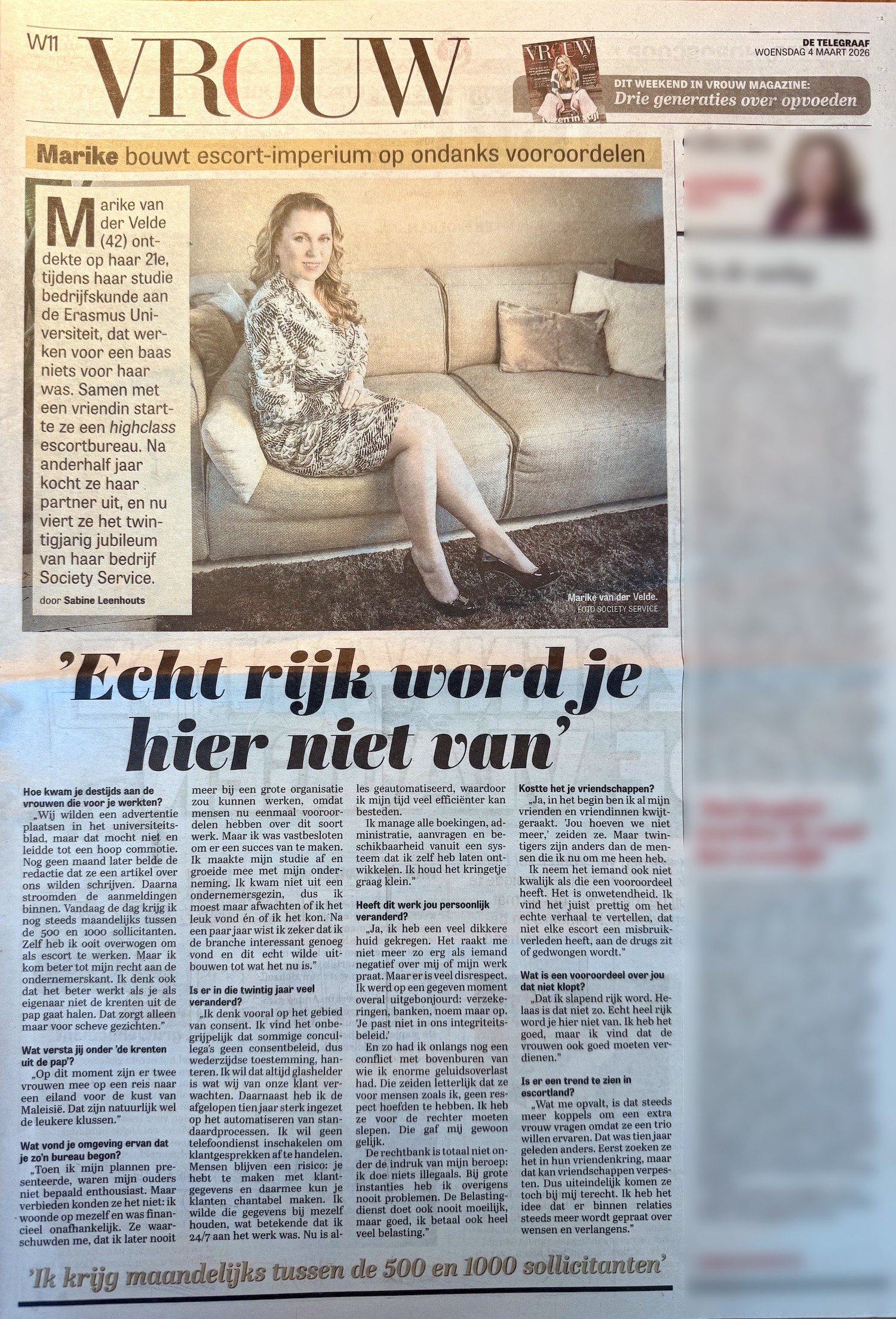
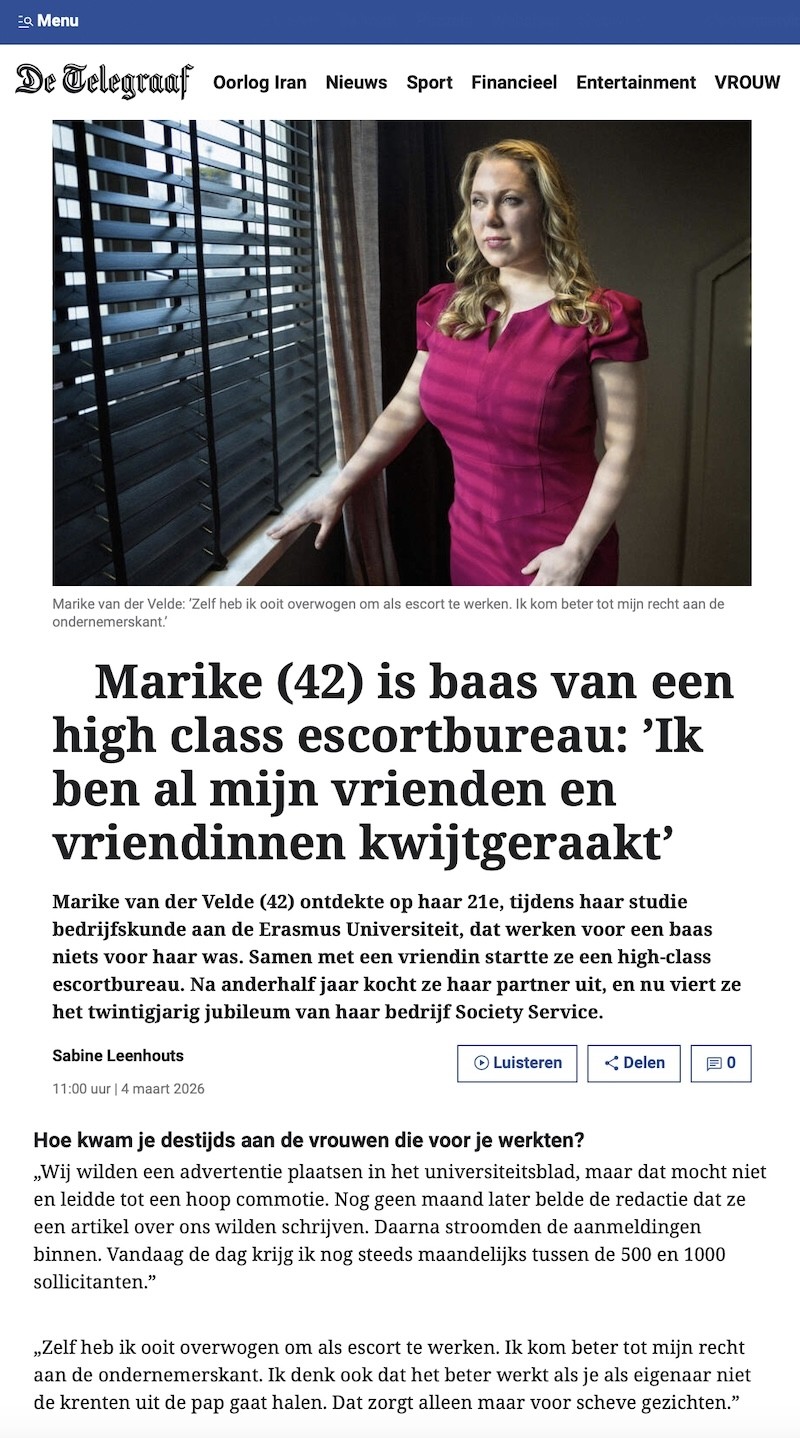
On March 4, 2026, De Telegraaf Vrouw published an interview with Marike van der Velden about the twentieth anniversary of Society Service, both in print and online. The article focuses on her entrepreneurial story: from starting during her student years to building a high class escort agency in an industry that still faces prejudice.
Below, the print version and the online version have been combined into one and translated to English. This creates a more complete picture of the interview, including both the editorial context from the newspaper and the additional passages from the online publication. The result is a continuous text in which entrepreneurship, stigma and the development of Society Service come together.
‘You don’t really get rich from this’
Marike van der Velden (42) discovered at the age of 21, during her Business Administration studies at Erasmus University, that working for a boss was not for her. Together with a friend, she started a highclass escort agency. After a year and a half, she bought out her partner, and now celebrates the twentieth anniversary of her company Society Service.
How did you find the women who worked for you at the time?
„We wanted to place an advertisement in the university magazine, but that was not allowed and caused quite a stir. Less than a month later, the editorial team called to say they wanted to write an article about us. After that, the applications started pouring in. Even today, I still receive between 500 and 1000 applications every month. I once considered working as an escort myself. But I was better suited to the entrepreneurial side. I also think it works better if, as the owner, you don’t take the best opportunities for yourself. That only creates tension.”
What do you mean by ‘taking the best opportunities’?
„At the moment, two women are on a trip to an island off the coast of Malaysia. Those are of course the nicest assignments.”
What did your surroundings think when you started such a business?
„When I presented my plans, my parents were not exactly enthusiastic. But they couldn’t forbid it: I lived on my own and was financially independent. They did warn me that I might never be able to work for a large organization later on, because it tends to trigger prejudice. But I knew this was what I wanted to do and I made that choice consciously. I finished my studies and grew along with my business. I didn’t come from an entrepreneurial family, so I had to find out whether I would enjoy it and whether I could do it. After a few years, I knew for sure that I found the industry interesting enough and wanted to build it into what it is today.”
Has a lot changed over those twenty years?
„I think mainly in terms of consent and boundaries. The consent policy we have in place now did not exist in the past. We work very clearly with that now. I find it hard to understand that some competitors do not have a consent policy. I want it to be completely clear what we expect from our clients. In addition, over the past ten years I have strongly focused on automating standard processes. I do not want to use a call service to handle client conversations or repetitive work. People remain a risk: you deal with client data, and that can make people vulnerable to blackmail. I wanted to keep that data in my own hands, which meant I was working 24/7. Now everything is automated, allowing me to use my time much more efficiently. I manage all bookings, administration, requests and availability from a system that I had developed myself. I prefer to keep the circle small.”
Has this work changed you personally?
„Yes, I have developed a much thicker skin. It doesn’t affect me as much anymore when someone speaks negatively or inaccurately about my work. But there is a lot of discriminatory behavior. You notice that, for example, with banks and insurance companies that make things difficult. At one point, I was rejected everywhere: insurance companies, banks, you name it. ‘You do not fit within our integrity policy.’ I also recently had a conflict with a neighbor who caused serious noise disturbance. He literally said they did not want me and my business there. I stood my ground and eventually took it to court. The judge ruled in my favor. The court is not impressed by my profession at all: I am not doing anything illegal. With large institutions, I generally do not encounter problems. The tax authorities never make things difficult, although I do pay a lot of taxes.”
Did it cost you friendships?
„Yes, in the beginning I lost all my friends. ‘We don’t need you anymore,’ they said. But people in their twenties are different from the people I have around me now. I don’t always blame people for having prejudices. When they take it out on me, it is usually not out of malice but ignorance. I actually find it important to tell the real story, one that is not just based on drugs and nightlife.”
What is a misconception about you that is not true?
„That I get rich without effort. No. You don’t really get rich from this. I do well, but I work hard for it. And yes, I believe the women should be well paid too.”
Is there a trend in the escort industry?
„What stands out is that more and more couples ask for an additional woman to try that experience. That was different ten years ago. At first, they look within their own circle of friends, but eventually they still come to me. I get the sense that within relationships there is more openness about wishes and desires.”